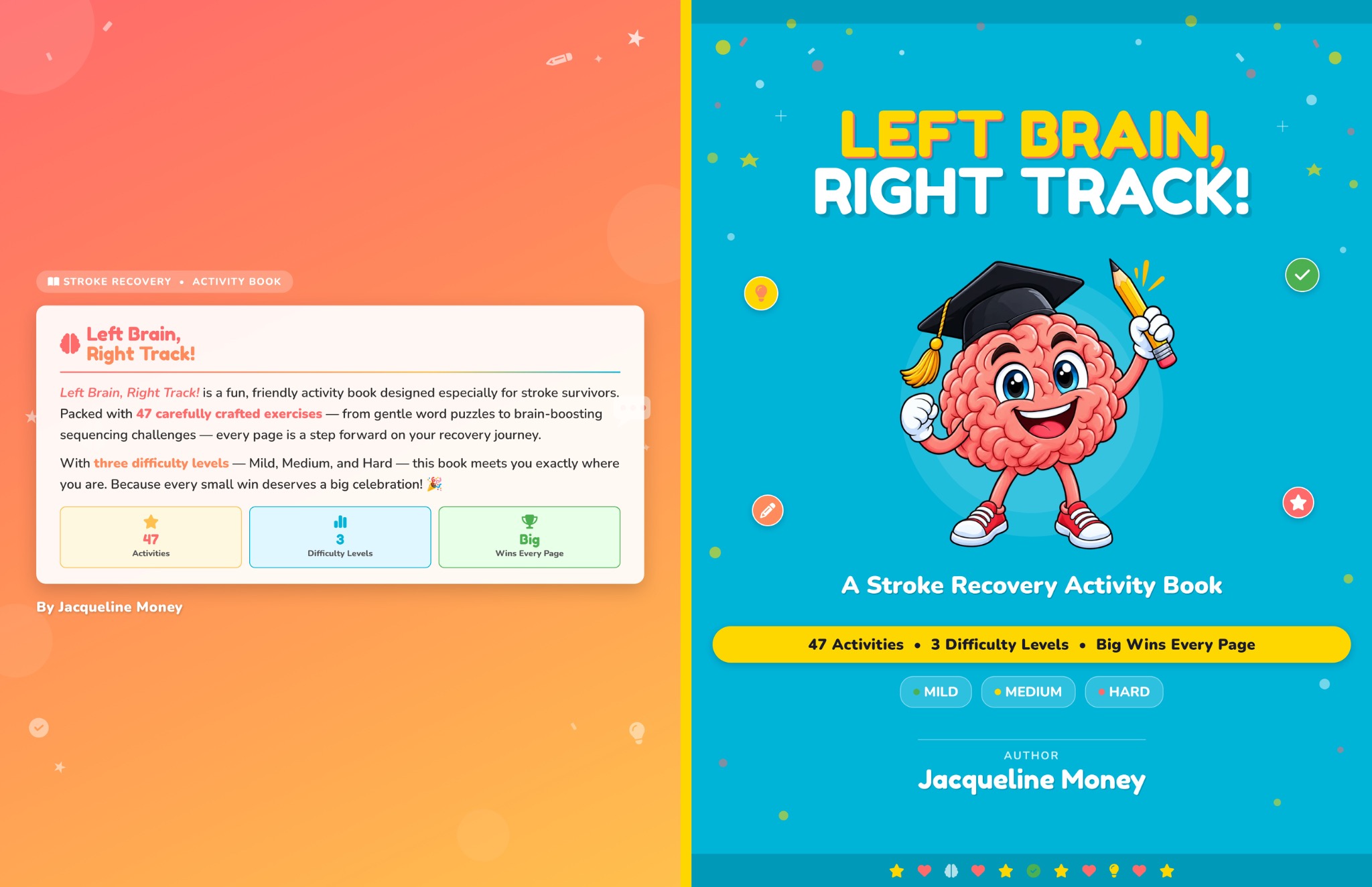
Who might find this book relevant?
The book is written for adults navigating challenges after a left-hemisphere stroke. It may also be useful for a caregiver who wants to look at the pages together, or for a rehabilitation professional deciding whether any particular page fits a person's interests and care plan. Stroke experiences differ widely: the American Stroke Association explains that rehabilitation should be individualized. A book cannot tell you which activities are appropriate for an individual.
If you need help with stroke symptoms, diagnosis, swallowing, or a personalized rehabilitation plan, speak with a qualified healthcare professional rather than relying on this book or this page.
What kinds of activities are inside?
The specific book contents matter more than a general promise about “brain games.” These are the four areas represented in the manuscript; no improvement in recovery is promised:
Language and word-finding
Sentence completion, matching, categories, opposites, spelling, recall, and short writing prompts.
Numbers in familiar contexts
Counting, clocks, coins, arithmetic, number patterns, and comparing amounts.
Sequencing and reasoning
Putting everyday steps in order, following instructions, spotting patterns, and mixed challenges.
Pen-and-paper coordination
Tracing, paths, shapes, and pencil-control pages. Participation may instead mean pointing or speaking when writing is not comfortable.
Some stroke survivors experience communication difficulties, including aphasia. The American Stroke Association's communication resources explain the range of possible issues and point readers toward qualified support. This book's word activities are not a substitute for speech-language evaluation or therapy.
What should a caregiver check before choosing a page?
- Ask what interests the person. Pick a page they want to try; do not assume that every activity is appropriate after every stroke.
- Start where the page feels manageable. The Mild, Medium, and Hard labels are choices, not a score or a prescribed progression.
- Offer flexible responses. The manuscript allows pointing, circling, speaking, drawing, or writing rather than one required method.
- Make room for pauses. The book's helper guidance encourages giving the person time and stopping when an activity causes pain, distress, or marked fatigue. The American Stroke Association notes post-stroke fatigue can be significant and recommends working with the care team on an appropriate plan.
- Ask the care team when unsure. A clinician who knows the individual can help judge whether a page is suitable and how it might complement—not replace—care.
Is an activity book the same as stroke rehabilitation?
No. Formal rehabilitation may involve a coordinated team and individualized work on movement, communication, cognition, daily activities, and more. An independently purchased workbook can provide an optional way to engage with printed activities, but it does not assess, diagnose, treat, or promise to restore lost abilities. Use the book as a supplemental resource, not as a substitute for professional advice or therapy.
Want to see an actual activity first? Try the free sample from page 5, watch the short book introduction with captions and transcript, then check the Amazon listing for current format, availability, and price.
Sources and editorial note
- American Stroke Association — Stroke Rehabilitation (individualized care and variation across survivors)
- American Stroke Association — Communication and Aphasia (communication-resource context)
- American Stroke Association — Fighting Through Fatigue (fatigue and care-team planning)